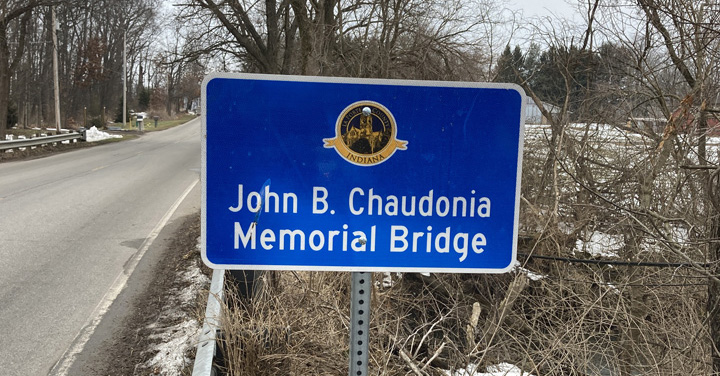
Jean Baptiste Chandonnai is mentioned in several Midwest history books and a footnote in several more. Most stories portray him as a hero who honorably served the United States and claim he was the nephew of Chief Topinabee. LaPorte County, Indiana, named a bridge after him. However, those histories failed to dive deep into records and relied on a few unreliable sources. Nearly all of them contain false information. When we examine multiple first-hand sources and refrain from whitewashing history, we discover a darker, more complex character. Chandonnai’s story provides a glimpse into the relationship between Native Americans, white settlers, and the will of the United States government. Read More

Red Devils & Slicers – the tale of two mascots
© Matthew A. Werner, 2025
Have you have heard that Michigan City Elston High School got its Red Devils nickname because it was built on an ancient burial ground? Or that LaPorte High School became the Slicers because the owner of the U.S. Slicing Machine Company loved basketball and sponsored the team’s uniforms? These stories are more folklore than fact. If you’ve ever wondered where these mascots originated, read on. This is the real story how the Red Devils and Slicers got their names.
Door Village Fort – the story behind the story
In LaPorte County, Indiana, there is a giant granite rock with bronze plaques on two sides dedicated to the Door Village Fort. As the story went, Chief Black Hawk was on the warpath, he and his warriors were murdering white settlers, and headed toward LaPorte. In response, noble pioneers banded together and constructed a fort in just three days to protect the good people from the marauders. Local children learned that story for a century. However, Black Hawk was not headed toward Indiana or murdering innocent settlers. The fort arose from a panic based on misinformation and hatred of Native American people.1Wyman, Mark. The Wisconsin Frontier (Bloomington: Indiana University Press, 1998), 146. “The outbreak was created from many strands, including white pressure on lands, and Indian resistance; tribal divisions, and strife between tribes. But the major cause of the Black Hawk War was the long-term buildup of fear and hatred between Indians and whites along the Mississippi.” (Click superscript numbers to view interesting notes) That panic launched the Black Hawk War, an ugly stain on American history. Read More
NOTES
- 1Wyman, Mark. The Wisconsin Frontier (Bloomington: Indiana University Press, 1998), 146. “The outbreak was created from many strands, including white pressure on lands, and Indian resistance; tribal divisions, and strife between tribes. But the major cause of the Black Hawk War was the long-term buildup of fear and hatred between Indians and whites along the Mississippi.” ↩︎

Home of the Satellites
© 2024
This history of South Central High School emphasizes its unique mascot, Satellites. Read the footnotes (by placing your cursor arrow over the small red numbers) for humorous tidbits, points of interest, and sources. The stories behind the Satellites history are as entertaining as they are charming.
The Totally Unreal Underground Railroad Superstar
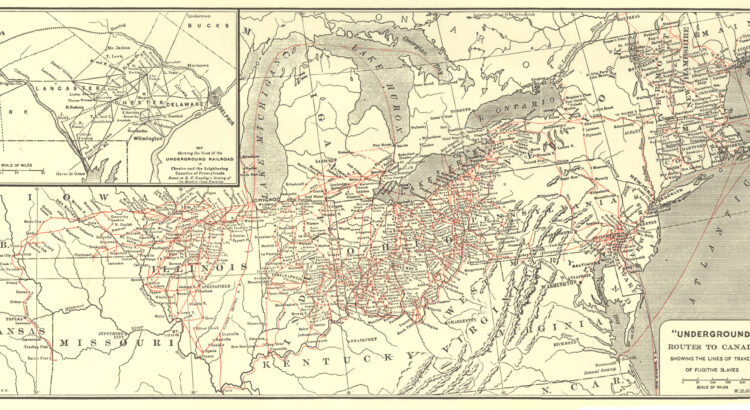
There is a fantastic story of a man named Daniel Low who guided 150 runaway slaves to freedom in northern Indiana. Lit candles on the widow’s walk atop his house instructed fugitives when it was safe to travel. Two ill fugitives died and were buried in Low’s own cemetery. His home was fugitive slaves’ last stop before being stowed aboard boats in Michigan City’s harbor and floated to Windsor, Canada. It is a good story and it most likely is a myth. Read More
Two New Books!
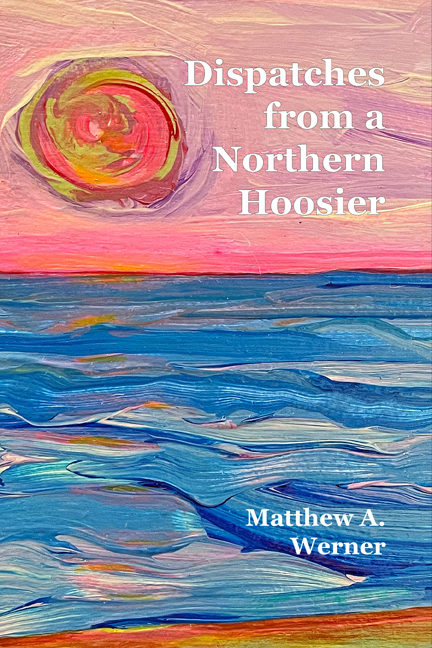
Author and LaPorte County, Indiana, resident, Matt Werner, has two new books published: “Dispatches from a Northern Hoosier” and “The Patch Players.”“Dispatches from a Northern Hoosier” is a collection of articles, essays, and history Werner wrote over the past 11 years. Some appeared previously; others are published in this book for the first time. They capture people, places, and events from northern Indiana.
His diverse subjects include an artist who expressed his cancer through art, a steel worker who wanted to be a writer, a mysterious South Shore train wreck, a Union Mills farm boy who spent 42 years in Major League Baseball, LaPorte County women’s basketball history, and tributes to everyday people like Warren Jones and Ron Clindaniel who made a difference in the lives of others.
“Everybody has a story to tell,” Werner said. “I’m just a guy trying to write it down.”

Indiana Basketball Lives On
Multi-Class Basketball May Have Saved Indiana Basketball
Matthew A. Werner & Richard J. Penlesky
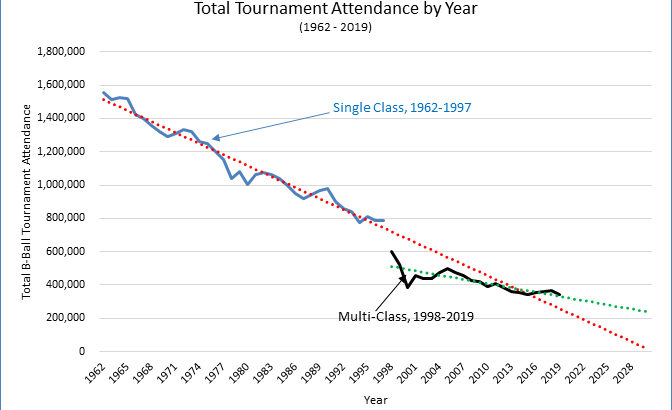
It’s been 25 years since single-class Indiana high school basketball was last played (1997), yet some Hoosiers still pine for its return. Curmudgeons claim that multi-class sports ruined Indiana high school basketball and they cite falling tournament attendance as evidence. Nobody has dug deep into the history and the data of class basketball. Until now. It turns out, multi-class basketball may have saved Indiana basketball. Read More
The Man Who Coached Two Basketball Teams
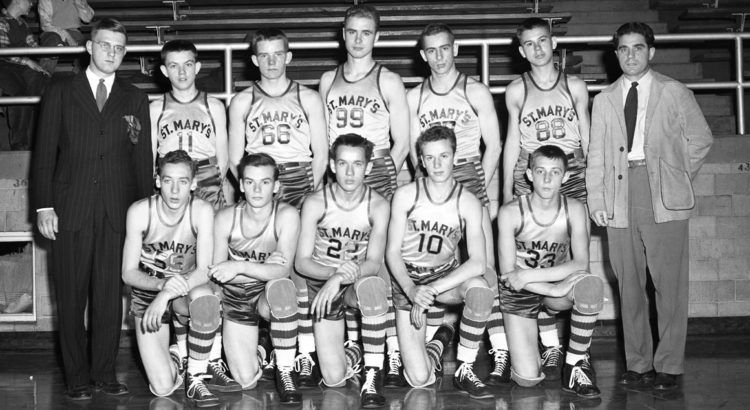
The Saint Mary’s High School basketball team in Michigan City, Indiana, prepared to play its first game of the season, just three days away; however, the team did not have a head coach. It was November 28, 1942 and Coach Tony Juska had joined the armed forces. Furthermore, World War II created a dearth of capable men available to coach athletics. Saint Mary’s had its eye on a candidate: Louis Sass. One problem—Sass already had a job coaching varsity basketball. Read More
Top Girls Basketball Players in LaPorte County History
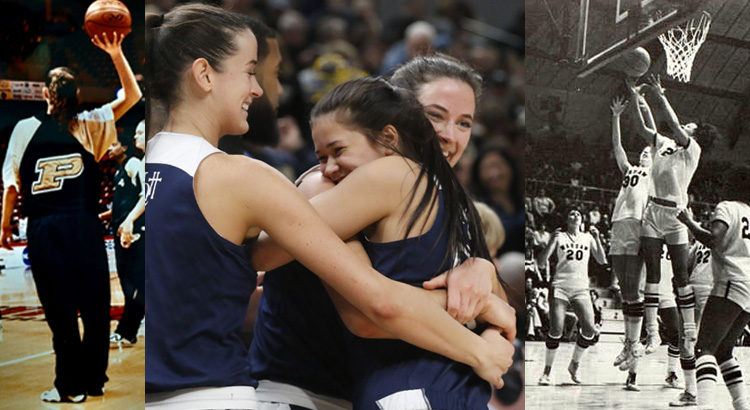
It’s time to recognize women who played basketball over the last 46 years. Read More
Basketball – A Love Story
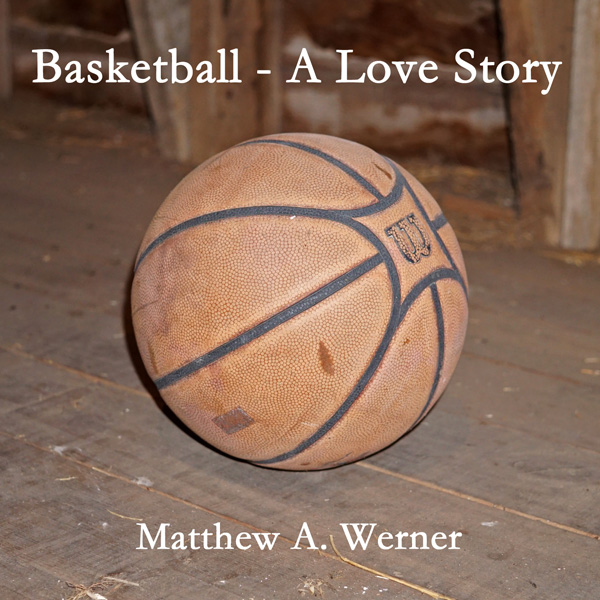
People around the globe play the game of basketball. In Indiana, basketball is part of the culture that bonds generations of Hoosiers. In “Basketball – A Love Story,” I explore that bond from shooting baskets in a barn as a kid to playing on the varsity team to watching a new generation of kids play for the love of the game. Many people will appreciate this story, as basketball really is a game played against oneself.
Originally written in 2016, this lent itself well to an audio story. Pat Wisniewski, documentary film producer of “Everglades of the North,” “Shifting Sands,” and “The Lively One” did the recording and production. The basketball sounds were recorded in the 80 year old barn on the Werner family farm. Click the PLAY arrow above and enjoy.
William Unger, Junior
7/3/1944 – 6/20/2020
William Nigel Unger, Jr. As if local tavern owners and bartenders hadn’t suffered enough grief in 2020, we lost a good one on June 20th. Read More
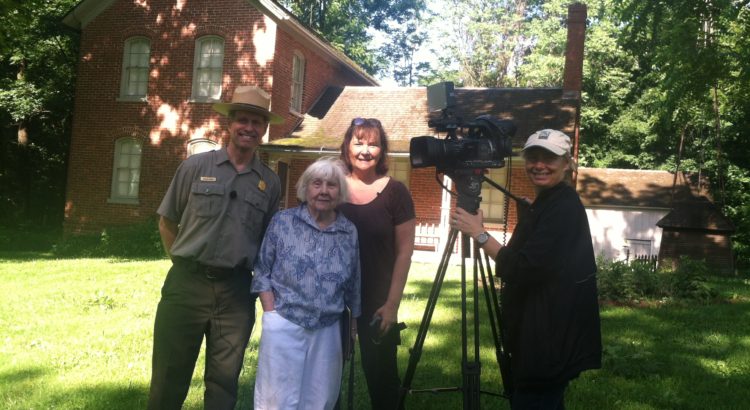
Pat Wisniewski – steel worker and documentary film maker
Two years ago, I wrote about Pat Wisniewski: mother, grandmother, steel worker, and documentary film maker. Patty has been doing the right thing for workers, artists, and the environment for decades. Now is a good time to re-share her story. (Wisniewski is 3rd from left in image above)
Patricia Wisniewski held her camera as she stood among a group of big, burly guys and one woman holding guns at a firing range. The woman asked her, “Do you shoot?”
“My Canon,” Wisniewski replied.
A short time later, the group crowded into a room and Wisniewski stood before them and made her sales pitch. She asked for $80,000 and official sponsorship so she could make a documentary film. The group deliberated. She was nervous. Then a man stood up and said, “I think we should do this.” The group was the Diana chapter of the Izaak Walton League and those words of support launched “Everglades of the North,” a documentary about the Grand Kankakee Marsh. Momentum from that film rolled to “Shifting Sands: On the Path to Sustainability,” about the Indiana Dunes. Read More
Michigan City White Caps players, 1957 – 1958
View a quick montage of individual player photos of the 1957 & 1958 White Caps baseball teams.
Each one is about 90 seconds.
Frank Howard – gentle giant
The following is an excerpt from a conversation I had with Glen Rosenbaum who played and worked in the White Sox organization for 42 years.
“I pitched against a lot of guys in the minors—D league, Triple A ball, Pacific Coast League—who went to the big leagues. Orlando Cepeda was the best hitter I ever faced. I was at Dubuque and he was playing in Kokomo at the time (1955). He attacked the ball. Oh man. You threw it to him and just hoped he hit it to one of the guys behind ya’. That’s all you could do really. Haha!
“Only one guy I was ever afraid to pitch to—Frank Howard. All the guys I ever pitched against, he was the only one who scared me. Read More

Coronavirus Sky
My dad and I were behind the barn and paused our work. There wasn’t a cloud to be found. Azure sky as far as our eyes could see.
I’ve never seen this in my whole life, I said. It’s so clear, so blue.
Yeah, me neither, my dad said with the sun at his neck. No airplanes, no contrails criss-crossing, no haze—nothing.
And to think, I said, this is what it’s supposed to look like. Read More
Analog or Digital (Eat Your Words, cont’d)
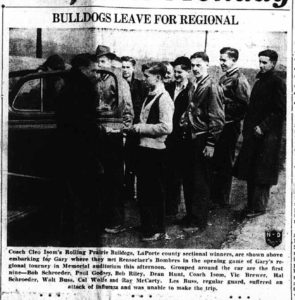
Foot after foot of microfilm spun off one reel and wound onto another reel. Old newspaper pages scrolled across a computer screen while my index finger held down the computer mouse button until I found the first week of March 1941. I slowed the reels and scanned for mentions of the Rolling Prairie Bulldogs. Five days of newspapers were missing, but the sixth day revealed a valuable image—a group of boys standing next to a sedan with its door held open. The caption read, “Coach Cleo Isom’s Rolling Prairie Bulldogs, LaPorte county sectional winners, are show above embarking for Gary where they met Rensselaer’s Bombers in the opening game of Gary’s regional tourney in Memorial auditorium this afternoon.”
Mr. Gierkey – 50 years with Staiger Hardware
Mr. William Gierkey began work at Staiger Hardware Store in Michigan City, Indiana on August 7, 1897. By August 7, 1946, he was still working there as a clerk and deliveryman. In fact, two co-workers had been there 40+ years–Staiger must’ve treated their employees well.
Because the photograph was taken with a film camera, the photo negative was there that day at 613 Franklin Street, greeted William Gierkey, captured his moment forever, and it is still with us today. Read More
Mystery Gym Had Studebaker Roots
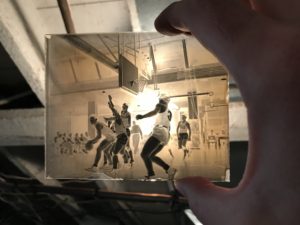
I found a glass negative among a box of old Michigan City, Indiana, photos. It had no description or identifying information. It was a basketball game.
As I peered through the glass, I thought, what a strange gym, and wondered, where was it? The hunt began.
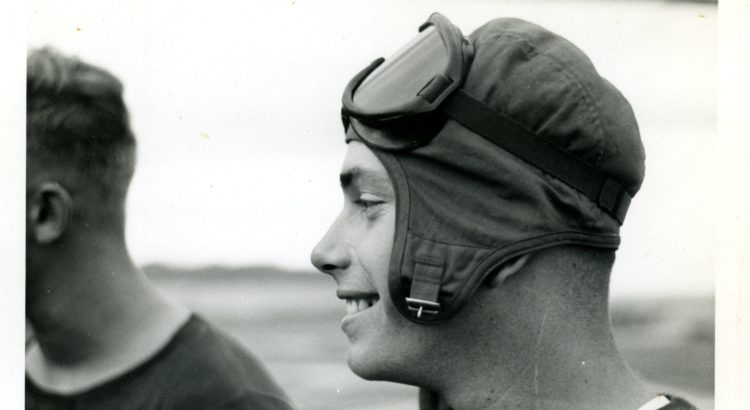
We Didn’t Turn the Boat Around – A Veterans Day Story
Twelve of the 15 coaches featured in the book, “Season of Upsets,” were veterans of World War II. Here is a Veterans Day excerpt from “Season of Upsets”:
We didn’t turn the boat around Read More
Sixty Years and Counting- A record that stands alone
In 2016, I interviewed Don Larsen for the 60th anniversary of the only World Series perfect game that he pitched. Here is the story.
October 8, 1956. A 27-year-old pitcher born in Michigan City, Indiana, crossed the chalked white line of Yankee Stadium in the Bronx, New York City, and took the mound against the Brooklyn Dodgers in game 5 of the World Series. Larsen was surprised to be there. Read More