
Jean Baptiste Chandonnai is mentioned in several Midwest history books and a footnote in several more. Most stories portray him as a hero who honorably served the United States and claim he was the nephew of Chief Topinabee. LaPorte County, Indiana, named a bridge after him. However, those histories failed to dive deep into records and relied on a few unreliable sources. Nearly all of them contain false information. When we examine multiple first-hand sources and refrain from whitewashing history, we discover a darker, more complex character. Chandonnai’s life reflected the difficult relationship Native Americans had with white settlers, and the will of the United States government.
© Matthew A. Werner 2026
LaPORTE COUNTY COMMISSIONERS MEET “JOHN B. CHAUDONIA”
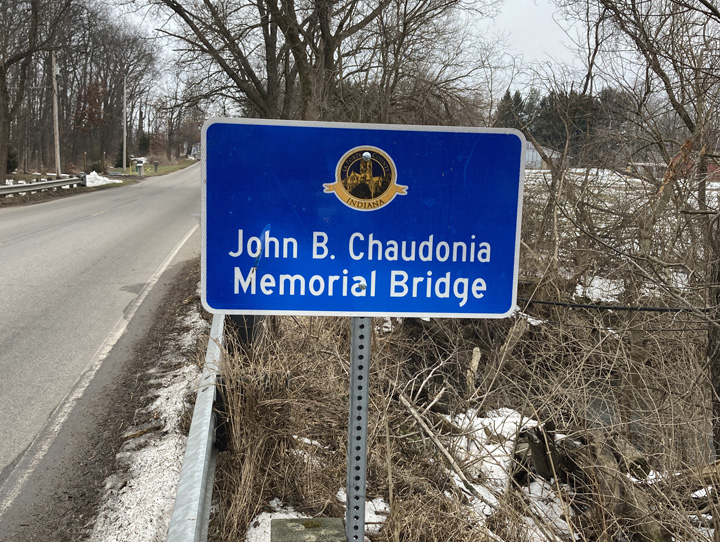
In Indiana, the LaPorte County Board of Commissioners named a bridge the “John B. Chaudonia Memorial Bridge.” This is it.
His real name was Jean Baptiste Chandonnai. This is his signature.

In a 2009 newspaper article, past LaPorte County historian Fern Eddy Schultz explained the different spellings of Chandonnai[1]:
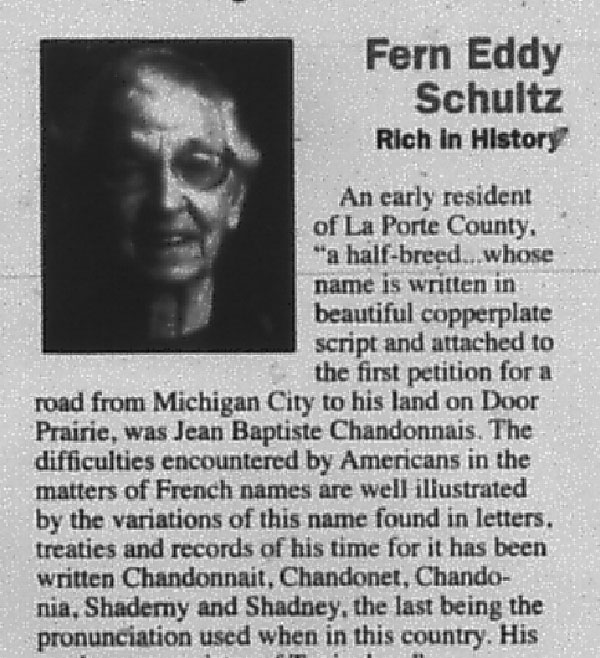
The spelling used on the bridge, “Chaudonia,” appeared once in 1846—nine years after J.B. Chandonnai’s death. The misspelling was the result of a transcription error.[2]
Not only was his name on the sign incorrect, but information used to name the bridge was incorrect and contradicted the opinions of LaPorte County settlers who knew Chandonnai. Local settlers described him as an intemperate man who placated Native Americans with alcohol and abused both a Potawatomi woman and his wife. (LaPorte County officials were notified of the inaccurate information before the sign was installed).
A member of the bridge committee, and current LaPorte County historian, Bruce Johnson, presented the following information to the Board of Commissioners:
“John B. Chaudonia was a Potawatomi Peacemaker. He was known to settlers here in LaPorte County as Shadney. His father was a fur trader. His mother was a sister to Chief Topinabee. He worked very effective in helping to keep peace with the government, settlers, and Potawatomi in LaPorte County and beyond. . . He received land in Scipio Township on section number 28 . . . for his help in solving problems with the Potawatomi.”
He read an excerpt of a letter written by Lewis Cass that described Chandonnai’s life as “almost romantic.” Here is the presentation:
(First 60 seconds)
(Next 15 seconds)
This is the first page of the bridge committee’s report given to the LaPorte County Board of Commissioners:
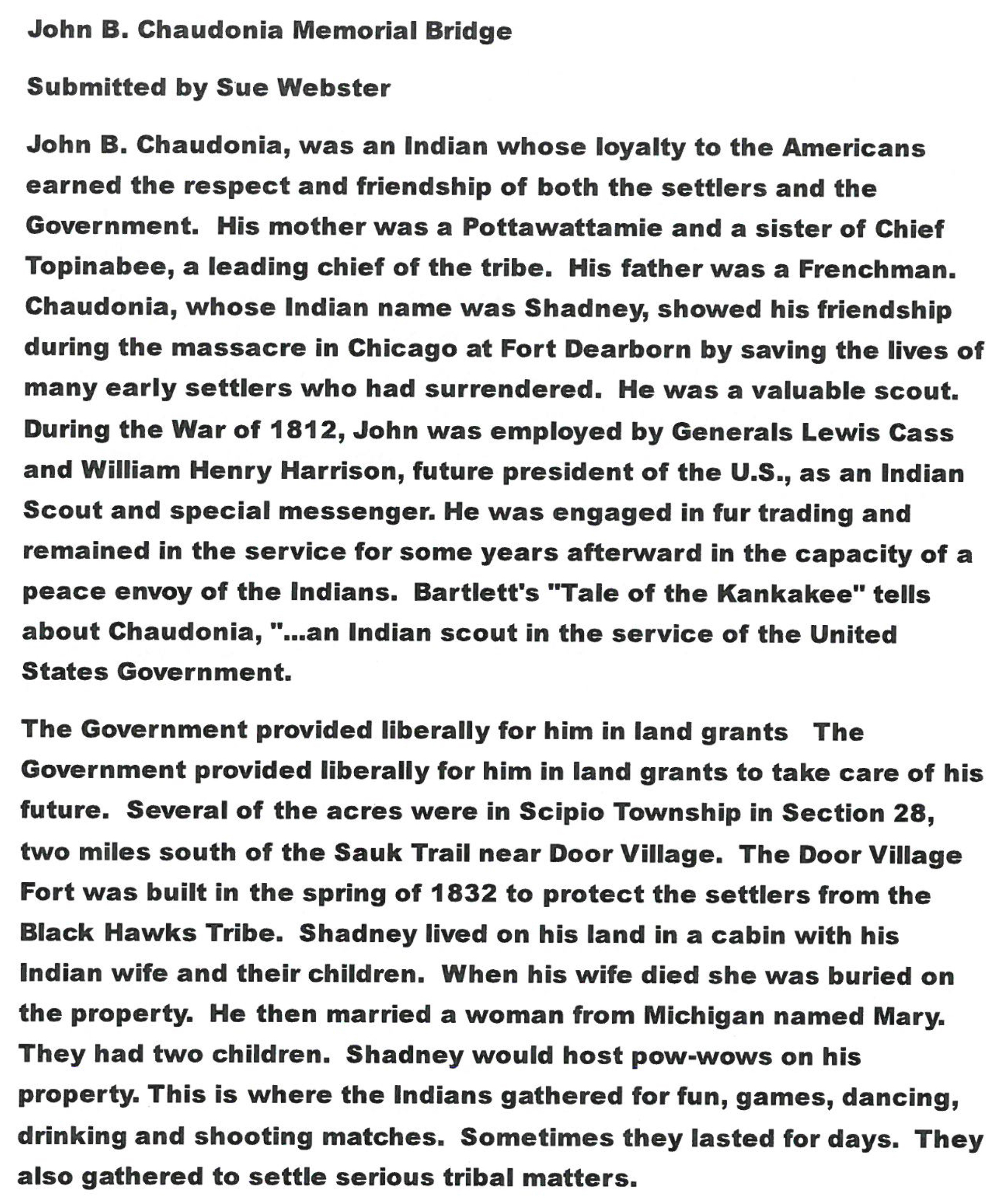
This story appears too good to be true for good reason. Most of this information is false.[4] In fact, more misinformation has been published about Jean Baptiste Chandonnai than accurate information.
We shouldn’t be surprised that nobody conducted thorough research of Chandonnai. He wasn’t important enough to garner great attention, so writers and historians copied the whitewashed stories and moved on. It was convenient that a part-Native American man supposedly devoted himself to the leaders of the United States in its dealings with tribes of the Great Lakes. It advanced the narrative that white U.S. government officials were noble. That is why we should look at Chandonnai’s life more thoroughly. His life tells a story that’s been overlooked—the relations between Native Americans, white settlers, and the U.S. government in the early 1800s.
The history presented here relies heavily on first-hand sources to learn who J. B. Chandonnai really was, something no historian has done before. What exactly were the “problems with the Potawatomi” and did Chandonnai solve them? Was Chandonnai Chief Topinabee’s nephew? Was Chandonnai a Potawatomi? Why did Door Village settlers in LaPorte County deride Chandonnai, but Lewis Cass praised him? Was he a heroic patriot, or a “soldier of fortune” as one historian called him? Who is the real Jean Baptiste Chandonnai?
JEAN BAPTISTE CHANDONNAI
Jean Baptiste Chandonnai was born in present-day Michigan in 1788 or 1789. His mother was Marguerite Marcot, the daughter of Jean Baptiste Marcot, a French fur trader, and Marie Neskech, an Odawa woman. According to Jean Baptiste’s baptism record, his father was Charles Agacouchin.[5] His father may have been French or French/Native American. Nothing more is known about his father other than he died sometime between 1794 – 1799. During his life and afterward, many people referred to Chandonnai as a “half-breed” Potawatomi.
Chandonnai was not the nephew of Chief Topinabee of the Pokagon Potawatomi. Here is Topinabee’s family tree assembled by Kyle Malott, a Potawatomi language expert:
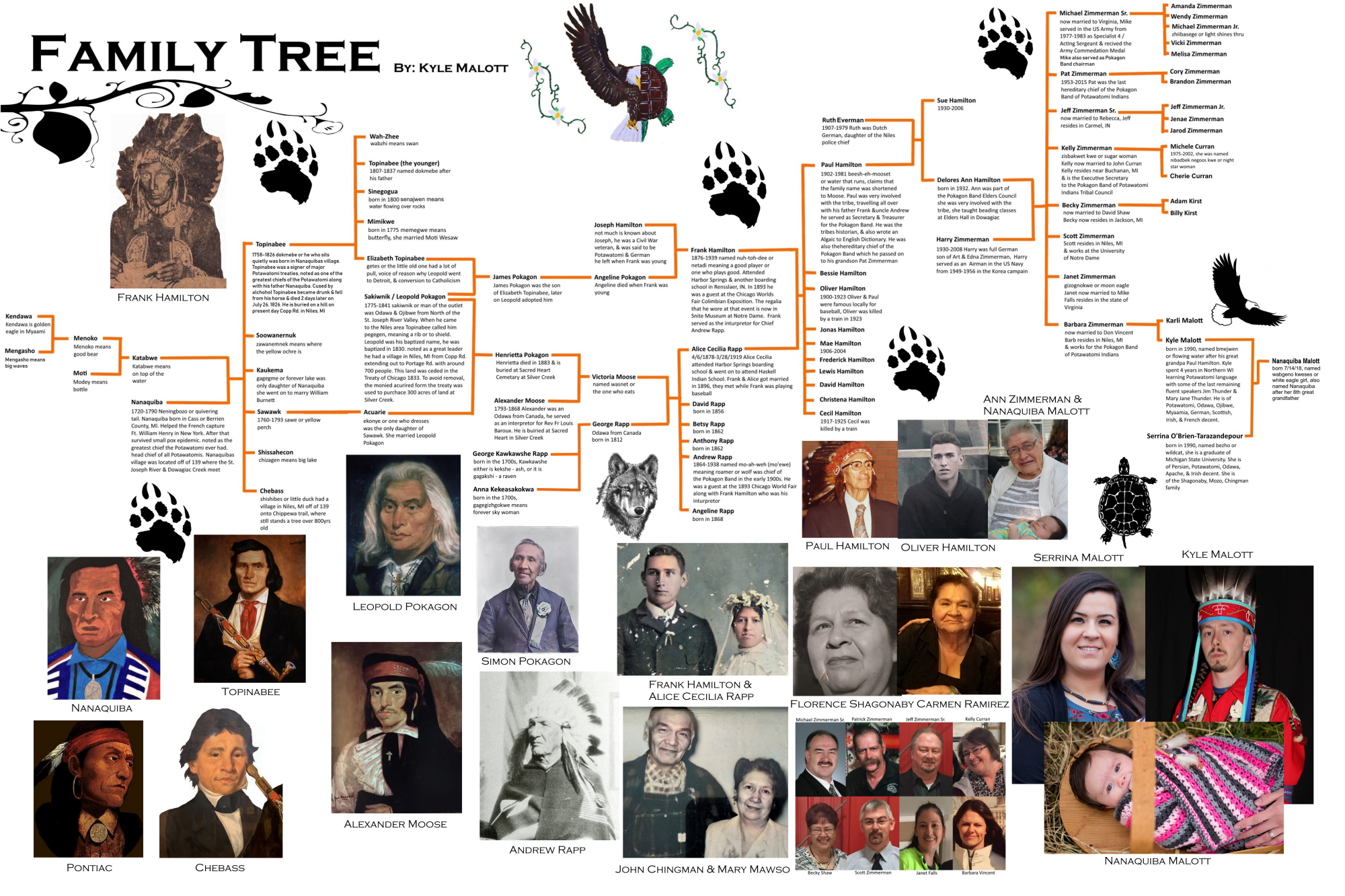
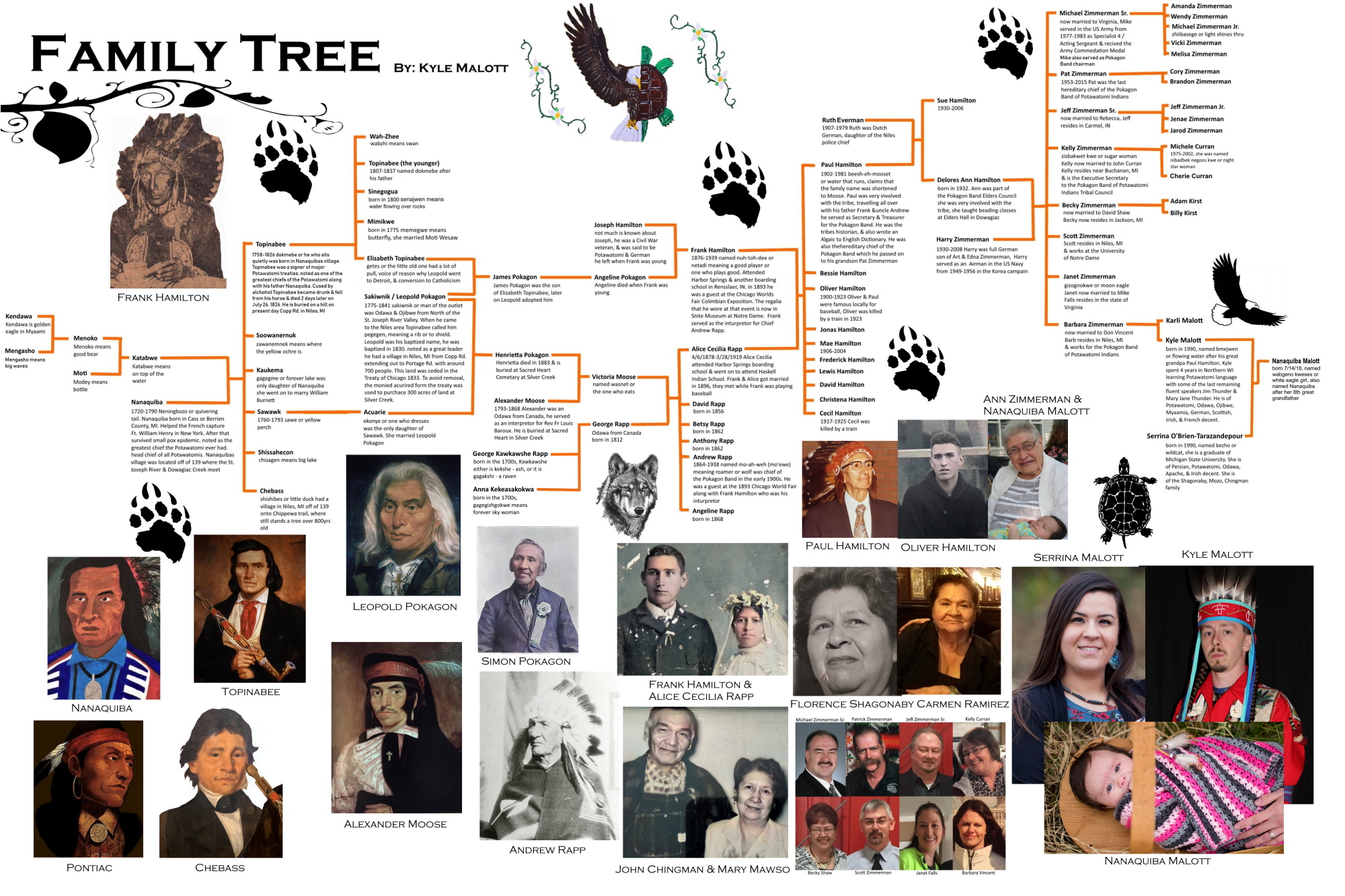
Lewis Cass is the only person to ever claim Chandonnai and Topinabee were related in a letter he wrote in 1843. Unfortunately, many writers and historians repeated this falsehood without verifying its accuracy. That letter is one of the documents that anointed Chandonnai as a hero. As we will see, Cass may have embellished Chandonnai’s life story in order to obtain benefits for his widow, whom Cass felt had been wronged by her dead husband.
Chandonnai grew up in the St. Joseph River Valley. His aunt, Charlotte Marcot, married Charles Chandonnet in 1792.[6] The couple had no known children and raised Jean Baptiste as their own.[7] Throughout the Michigan Territory and beyond, people regarded Charles as Jean Baptiste’s adopted father. On July 16, 1804, Jean Baptiste witnessed a wedding alongside Charles in Mackinac and signed his name, “J. B. Chandonnet.”[8] He later changed the spelling of his last name.
Chandonnai befriended John Kinzie. In 1812, he lived in Chicago and worked for Kinzie engaged in the “Indian trade,” trading furs and goods with Native Americans.
He was in Chicago on August 15, 1812, when the Battle of Fort Dearborn was fought two miles away. After the battle, Chandonnai negotiated a trade that included “an old mule captured there and a bottle of whiskey” to get Captain Nathaniel Heald and his wife, Rebecca, together, rather than taken prisoner by separate Native American Bands. He then accompanied prisoners, including the Healds, east to the mouth of the St. Joseph River in Michigan Territory and accompanied John Kinzie’s wife on to Detroit while John Kinzie stayed behind in Chicago. The Healds went north to Mackinac.[9]
Chandonnai spoke English, Potawatomi and probably French and Odawa. During the War of 1812, he worked as an interpreter. First, he began working as an interpreter for the British under Robert Dickson beginning on February 20, 1813. On March 13, Dickson commissioned his uncle and adopted father, Charles Chandonnet, as a lieutenant to the agency of Indians of the Western Nations for Great Britain.
In a letter dated March 15, 1814, Dickson wrote, “Mr. Chandonnet might as well have passed the Winter with His Holiness, the Pope, at Rome. He did not procure intelligence from St. Joseph, for which I sent him. His reason for his failure is unsatisfactory. I would not give two pence a dozen for such people.”[10]
December 1813, Chandonnai, Isaac Burnet, and B. Ducharme took Charles Bailey, a British trader on the Grand River at Lake Michigan, prisoner and transported him to Detroit in the name of the United States. This harmed the Native Americans of the region as it removed a valuable trader of goods from the area and few traders risked conducting business in the vicinity. That action was “the cause of their present misery” of the people of the Grand River Valley according to one British officer.[11]
The British arrested Chandonnai in 1813 near Detroit for “being detected in a correspondence with the Enemy and misleading and deceiving the Indians,” according to Lieut Joseph Cadotte.[12] He was housed in Fort Amherstburg and escaped.
Historian Lyman C. Draper wrote of Chandonnai’s service during the War of 1812, “from Col. Dickson’s letters, it would seem that Chandonnai was a soldier of fortune, and served wherever his interests dictated.”[13] Chandonnai and John Kinzie were allegiant to Great Britain, and both served His Majesty’s Indian Department and then worked for the United States.[14]
J.B. Kills His Adopted Father
In June 1814, Jean Baptiste shot and killed his adopted father, Charles Chandonnet, near the mouth of the St. Joseph River. Jean Baptiste and Robert Forsyth traveled there on behalf of the U.S. government to encourage Potawatomi leaders of the St. Joseph and Lake Michigan bands to attend a council in Greenville, Ohio.[15] Charles also arrived there on behalf of the British government to consult with the Potawatomi and to take Jean Baptiste prisoner to Mackinac if he encountered him.[16]
Later versions of the story, told by people who were not present, claimed that Jean Baptiste feared for his life, drew a line in the sand that Charles crossed, and had deep regrets for the murder. However, the sole eyewitness account known to exist tells a different story. Odawa Chief Assignack stood 15 yards away from Charles when he was killed. Under oath, Assignack described the incident thusly: “Lt. Chadronet on landing found J. B. Chadronet on the Beach and told him he was his Prisoner. The other seizing his rifle, threatened him if he approached which Lt. Chadronet disregarded, he presented and shot him.”[17]
LEWIS CASS MEETS CHANDONNAI
Chandonnai worked as an interpreter for the United States Department of War and Bureau of Indian Affairs. At one point, he was paid $1 per day.[18] In addition to interpreting for parties that spoke different languages, interpreters gathered and disseminated information between United States War Department and Native American tribes. On July 22, 1814, he worked as a sworn interpreter at a treaty between United States and the Wyandot, Delaware, Shawnee, Seneca and Miami in Greenville, Ohio (Treaty #60). On that treaty, he signed his name, “J. Bte. Chandonnai.” That is how he signed his name for the remainder of his life.
Afterward, he accompanied General Lewis Cass, Governor of the Michigan Territory, to Detroit. Before that trip, Cass wrote to John Armstrong:
“I would merely observe, that every white man, who can speak one of the Indian languages ought to be taken into pay. The stated compensation of one of them does not equal the amount expended for the pay and support of two private solders, and there can be no comparison between the services to be rendered by them. . . “I am no enthuse[a]stic believer in Indian friendship and professions, but I have no doubt but important advantages will result from their assistance and cooperation. I have so little doubt of the sincerity of those who are here, that I shall entrust my person and life to a part of them, who will tomorrow accompany me through the woods on my journey to Detroit and with no white men in Company except three Interpreters.”[19]
Here, Cass revealed his disdain for Native American people. He believed that all Native American people should be relocated far away from valuable land that white people desired and that they should not interact with white Americans any more than necessary.
As President Andrew Jackson’s Secretary of War in the 1830s, Cass would implement Jackson’s brutal Indian Removal policies. Furthermore, his observations indicate if Chandonnai were part Potawatomi, he did not live his life as a Potawatomi, or Odawa for that matter, but rather as a white man.
One of the “problems with the Potawatomi” was that white Americans wanted the Potawatomi’s land and the Potawatomi gone.
The War of 1812 ended February 17, 1815.
April 25, 1815, Chandonnai issued a memo as an interpreter, detailing his recent travels to deliver a “memo of peace to the Indian tribes west of Detroit by order of William Woodbridge.” Setting out on March 1, he got about 100 miles away and camped in a village that had 40 lodges. The Native Americans there advised him to travel to Fort Wayne, where the principal chiefs were. They also told him that “the Indians of the Grand River were badly disposed as also all the Lake Michigan Indians and they considered that I would be in personal danger and that a premium was offered for my scalp and that of my friend John Kinzie.”[20]
As a result, Chandonnai did not proceed toward Lake Michigan or Grand River as instructed, but traveled to Fort Wayne instead. There, someone told him that British Lieutenant Cadotte had put an $800 bounty on his head and that four Potawatomi war chiefs intent on fulfilling that bounty had arrived in Fort Wayne. He left Fort Wayne and went back to Detroit. Along the way, he claimed to encounter another Indian who told him a party of three Native Americans led by a half-Ottawa-half-Potawatomi man named Naikeisee had intended to murder Chandonnai and Kinzie in Detroit to collect the bounty.[21]
Yes, the Native Americans of the western shore of Lake Michigan were unhappy with Chandonnai and Kinzie. Murdering Charles Chandonnet, taking away the traders with whom they dealt, and scaring away potential traders left them in a difficult situation. During the War of 1812, Lt. Joseph Cadotte of the British Indian Department told Native Americans of the Grand River to take Chandonnai and Kinzie prisoner to Mackinac. “He offered them 400 plus to bring them in alive. The Indians replied that they knew these men, had deterred the Traders of their English Father from coming amongst them, & relieving their misery; that they would therefore do all they could to take them whatever opposition be made, as they did not wish them to come on their Lands.”[22]
There was no bounty for Chandonnai’s scalp and no evidence that anyone attempted to murder Chandonnai or Kinzie from these rumors.
Chandonnai married Marie Louise Chapotton at St. Anne Church in Detroit on August 8, 1815.[23] A month later, he worked as interpreter at the treaty between the U.S. and Wyandot, Delaware, Seneca, Miami, Chippewa, Ottawa, and Potawatomi (Treaty #70) at Spring Wells near Detroit. John Kinzie also was an interpreter. Sometime in the following 12 -13 months, he returned to Chicago with Kinzie and again took up the Indian trade.
July 24, 1816, Jean Baptiste and Marie’s first child, Charles, was born in Detroit. Mother and child arrived in Chicago in 1817. Chandonnai worked with Kinzie in Chicago and a good amount of his business included buying alcohol and trading it to Indians for their goods. In a September 19, 1818, letter, Ramsey Crooks, agent of the American Fur Company, informed Chandonnai that he would receive four barrels (144 gallons) of whiskey from the American Fur Company and another two barrels he’d left behind in Michilimackinac via the boat ‘Hercules.’ Crooks informed Chandonnai that his order for more whiskey couldn’t be filled because “spirits of every kind are not only dear but uncommonly scarce.”[24]
Chandonnai wasn’t keen on paying his bills. August 11, 1819, Ramsey Crooks wrote to John Kinzie asking for helping in securing Chandonnai’s debt.
“With surprise and astonishment I learn the very questionable course Mr. Jean Bte. Chandonnait has thought proper to pursue,” Ramsey wrote, “. . . he had in his possession $1000 arising from the sale of his peltries to Mr. Crafts. At your recommendation I gave him credit, for without that I never would have trusted him a dollar, and your being on the spot where he resided, I certainly felt as safe as with the best man we deal with. Strange and unaccountable it is, that we have not received any kind of remittance . . . I am bound to hope . . . that you have done and will continue to do all in your power to insure the payment of our claim, at no very distant day. He owes upward of $4,000.”[25]
Some of that debt was not collected for another 14 years when the U.S. government granted money to Chandonnai through a treaty and part of it was paid directly to the American Fur Company.
Of the many treaties with Native Americans in the Great Lakes region, historian Milo Quaife, PhD, wrote, “The traders and their half-breed families and their descendants, shrewder and more influential than the full-blooded Indians, provided for their future welfare by procuring the reservation to themselves of generous tracts of land. That these special grants of land were obtained by the use of improper methods and influences, as [Rev. Isaac] McCoy has charged, can scarcely be doubted.”[26]
Chandonnai’s history demonstrated Quaife’s point. At the Chicago Treaty (#117) with the Ottawa, Chippewa and Potawatomi, August 29, 1821, Chandonnai was granted two sections of land on the St. Joseph River in the Michigan Territory as he was the son of Chip-pe-wa-qua. “Chip-pe-wa-qua” was not someone’s name—it is a Potawatomi and Odawa word that translates to “Odawa woman.” Joseph Daze also was granted a section of land adjacent to Chandonnai’s because he too was the son of “Chip-pe-wa-qua.” There is no evidence that the two men were related.[27]
Lewis Cass personally oversaw the Chicago Treaty of 1821 as Commissioner of the United States. Chandonnai’s friends, John Beaubian and John Kinzie, were official signatories on the treaty. Surely, they would have vouched for Chandonnai if need be. It’s likely Cass didn’t know what Chip-pe-wa-qua meant and no translator explained it to him, or nobody cared, and so it went. Regardless, Chandonnai received two sections of land (more than 1,000 acres) and he and his children would receive several more land grants in subsequent treaties.
Given Chandonnai’s familiarity with the Potawatomi, treaty officials, and white traders who often held the upper hand in treaties, it should not be a surprise that he and his family secured so much land. Many men in Chandonnai’s position attended these treaties and successfully angled to secure land, cash, or goods for themselves. According to Milo Quaife, “The policy of bribing the leaders among the Indians was deliberately adopted by the agents of the government, including such men even as Lewis Cass.”[28]
Although Chief Topinabee was not Chandonnai’s uncle, his real nieces and nephews benefited at this treaty. Topinabee had only one sister: Kaukema. Chandonnai knew her and her husband, William Burnett, a trader in the St. Joseph River Valley. Burnett was instrumental in persuading Potawatomi to accept the Americans treaty offerings. The Burnett’s children received six sections of land (3,500 – 3,800 acres) at this treaty.[29]
In 1822, Chandonnai’s daughter, Mary Louisa, was born. November 11th of that year, Chandonnai signed a petition to keep Michigan a territory rather than become a state.
LEWIS CASS WRITES A LETTER ABOUT CHANDONNAI
On January 31, 1823, Chandonnai wrote to President James Monroe petitioning to sell his second section of land along the St. Joseph River granted to him by the U.S. government. In his letter, he indicated he used proceeds from the sale of the first section of land to settle debts and he would use the sale of the second section to “purchase, horses, cattle, & farming utensils, to commence farming on the lands served by said Treaty for the use of the Indians, & upon which he [Chandonnai] is entitled to locate himself.”[30] In his letter, Chandonnai identified himself as “the son of Chip-pe-wa-qua,” fully aware what that word meant and that his mother’s name was Marguerite Marcot.
Of Chandonnai’s petition, Michigan Territory Delegate Soloman Sibley wrote, “I have nothing to remark on the subject of the Petition—further than my belief that the land reserved will never be cultivated, so long as it remains in the possession of Chandonnai.”[31]
On March 22, Lewis Cass wrote, “Two sections were granted to him at the treaty of Chicago as a permanent provision for his family. One of these he has obtained permission to sell, and if the same permission were granted for the other, I am certain he would soon be left destitute. . . I should regret exceedingly to see him destitute of property, and yet his habits are such as to render it improbably he would long retain any which he had the power to sell. This section of land offers a secure retreat for his wife and children, and the only chance for them to enjoy it is to withhold the permission he requests.”[32]
Chandonnai’s petition was denied.[33]
Throughout the 1820s, Chandonnai likely remained in the St. Joseph River Valley, perhaps on his section of land there. He wasn’t given to farming according to Sibley and probably continued in Indian trading and may have done a fair business selling alcohol.
In 1828, he was employed by the U.S. government to travel west to Kansas. Reverend Isaac McCoy, a Baptist missionary at Carey, Michigan Territory, was appointed a commissioner of U.S. Indian Affairs, and assigned to take a contingent of Odawa and Potawatomi from Michigan to Kansas to view land reserved for their relocation. Chandonnai served as interpreter on that trip. According to McCoy, Chandonnai injured himself at least twice on the trip while intoxicated.[34]
McCoy kept a journal of the trip and mentioned Chandonnai several times. On September 11, McCoy wrote, “Chandonois performs his part well, and is my main dependence.” October 7, he wrote, “Gosa [an Ottawa representative on the trip] tells me all that passes among them [the Native Americans on the trip]. . . Gosa goes so far as to say that Chandonois also has endeavoured to discourage them, and has not only found fault with the country but said that should the Indians settle in it, they would soon be driven thence by the influx of white population.” Oct. 9, McCoy wrote, “I am glad that our Indians are likely to go without Chandonois. He is a murderous fellow, and in a frollick on the road might kill some of them. His horse has a severe wound on the head made no doubt with a tomahawk in an attempt of Chandonois to kill him.”[35]
On this trip, Chandonnai visited Captain Nathaniel and Rebecca Heald at their home outside St. Louis.
CHANDONNAI IN LAPORTE COUNTY, INDIANA
By 1831, Chandonnai had relocated to LaPorte County, Indiana. There, he kept a Potawatomi woman, known only as Kesis, as his wife. There also was a child, Louis, who may have been the son of Chandonnai and Kesis. He had no legal right to the property on which he lived. His wife Marie, son Charles, and daughter Mary Chandonnai apparently remained in the Michigan Territory.
In 1874, Jasper Packard, the editor of The LaPorte Chronicle, interviewed the earliest white settlers in the county to preserve their history and published subsequent stories in a series in his newspaper. This is what he gathered and published about Jean Baptiste Chandonnai:

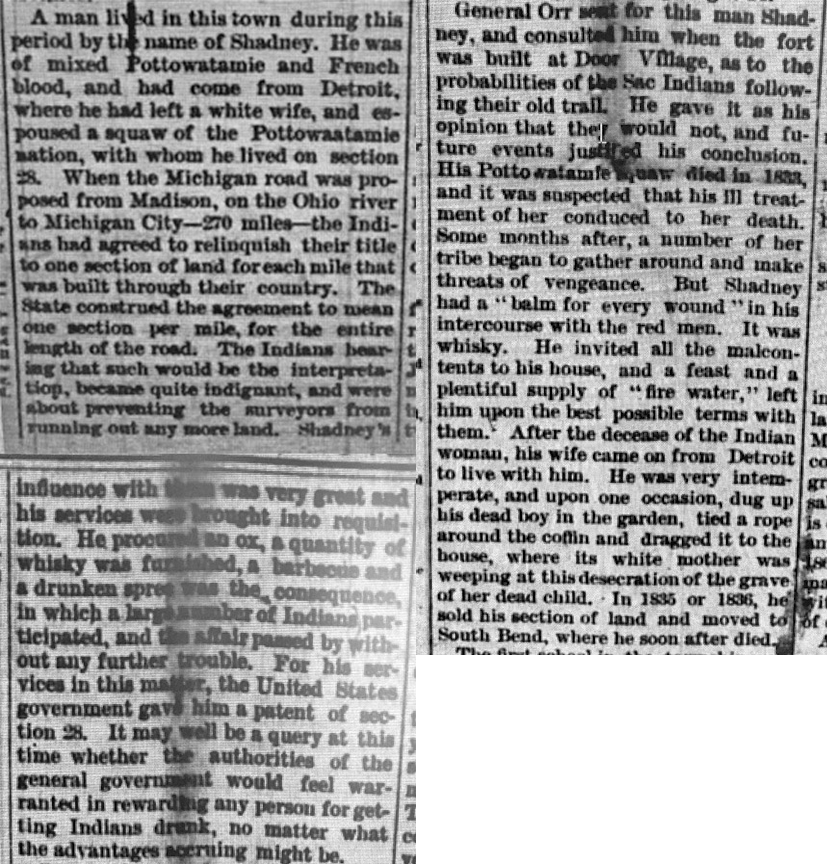
The settlers of Door Village told of a man “by the name of Shadney. He was of mixed Pottawatamie and French blood, and had come from Detroit, where he had left a white wife, and espoused a squaw of the Pottawatamie nation, with whom he lived on section 28.”
The story ran on how the Potawatomi were upset over the surveying of the Michigan Road and they, “became quite indignant, and were about preventing the surveyors from running out any more land. Shadney’s influence with them was very great and his services were brought into requisition. He procured an ox, a quantity of whisky was furnished, a barbecue and a drunken spree was the consequence, in which a large number of Indians participated, and the affair passed by without any further trouble. For his services in this matter, the United States government gave him a patent of section 28.”[36]
Here is where folklore and history intersect.
There was a fundamental disagreement between the United States and Potawatomi over Michigan Road land cessations. It was a lousy deal for the Potawatomi, especially since the language and subsequent interpretations were unclear. Potawatomi were frustrated. Surveyors had been surveying land that the Potawatomi hadn’t ceded, the federal government hadn’t approved to be surveyed, and it wasn’t even adjacent to the Michigan Road. This led John Tipton, Indian Agent in Indiana, to hold the Council at Potawatomi Mills on Tippecanoe River, August 20 – 31 and September 4, 1831.[37]
Partial agreement was reached that allowed surveyors to continue their work, but the council didn’t settle the land dispute between the Potawatomi and United States government to the selection of land north of the Kankakee River.[38] Tipton promised that the federal government would investigate the matter and the Potawatomi would be fairly paid for all land taken.
Chandonnai served as an interpreter during the council and requested 640 acres in payment for his services, which the state commissioner agreed to do and set section 28 in LaPorte County aside for him. That section was officially granted the following year. He would also receive an additional 603 acres of land.
According to oral history, during the Black Hawk scare in 1832 General Robert Orr asked Chandonnai whether Black Hawk might come to Door Village[39]. Chandonnai accurately told him, No. Black Hawk wasn’t a threat to anybody in Indiana, or anywhere else for that matter. The whole frenzy was the result of misinformation and white settlers’ disdain for Native Americans. White settlers had built a makeshift fort anyway.
In October 1832, agents for the United States government met with members of the Potawatomi along the Tippecanoe River to sign two treaties that ceded more land to the United States. They were signed on October 26 (Treaty #175 with Wabash and Elkhart Bands) and October 27 (Treaty #177 with St. Joseph, Coldwater, Wabash, and Elkhart Bands).
Treaty 175, Chandonnai was granted “One Section of land in the Door Prairie where he now lives.” Treaty 177 stipulated the following land grants: “To Kesis-Shadana, one section; To Louis Chadana, one-half section; To Charles Chadana, one-half section; To John B. Chadana, one section.”[40] He signed his name, “Jean Bte. Chandonnai,” as a witness to the second treaty.
Packard’s story of Chandonnai continued. Kesis died in 1833 and, “it was suspected that his ill treatment of her conduced to her death,” according to the early settlers. “Some months after, a number of her tribe began to gather around and make threats of vengeance. But Shadney had a ‘balm for every wound’ in his intercourse with the red men. It was whisky.” Chandonnai invited the “malcontents to his house, and a feast and a plentiful supply of ‘fire water,’ left him upon the best possible terms with them.”
This is the second story in local lore in which Chandonnai placated Native Americans with alcohol and a good time. Both stories relied upon stereotypes of Native Americans as fools who could be bought with trinkets and booze. Apparently these were the other “problems with the Potawatomi” that Chandonnai helped resolve. There is no record of any hostile Potawatomi people toward white settlers in LaPorte County, Indiana.
After the death of Kesis, Chandonnai’s wife, Marie, and possibly their children, Charles and Mary, came to live on section 28. Packard’s oral history reported that Chandonnai, “was very intemperate, and upon one occasion, dug up his dead boy in the garden, tied a rope around the coffin, and dragged it to the house, where its white mother was weeping at this desecration of the grave of her dead child.” That child could have been Louis who may have been the son of Kesis, not Marie.[41]
At the Treaty in Chicago (Treaty #189) on September 26, 1833, Chandonnai received $3,500, in lieu of land, of which $1,000 went to Robert Stuart of the American Fur Company on his behalf to pay old debts. His children, Charles and Mary, each received $400 “for each of whom R.A. Forsyth is trustee.” Why Robert Forsyth was entrusted to manage the payments to Chandonnai’s children, rather than Chandonnai, likely was due to his character mentioned in Cass’s 1823 letter as well as his reputation for drunkenness and poor handling of money.
At this treaty, white and mixed-race traders made off with $175,000 in cash for repayment of claimed debts owed by Native Americans. The list of mostly Anglican names who received cash in lieu of land reservations, as alleged Native American descendants, reached $110,000.
In 1834 in LaPorte County, Chandonnai was indicted for “selling spirits to Indians.”[42]
All told, Chandonnai was granted at least four sections of land totaling 2,000 – 2,500 acres in Michigan and Indiana and at least $3,500 via different treaties. In 1836, he sold his second section of land along the St. Joseph River in Michigan. He probably sold section 24 (604 acres) in present-day Lake County.[43] On November 3, he sold the section of land granted to Kesis (578 acres), falsely claiming the U.S. government granted it to him.[44] (In 1846, Charles Chandonnai and his brother-in-law, Lewis Breesett ,sold the land granted to Louis Chadana. An entry in the Porter County deed transfer records, dated April 23, 1857, indicated both properties—land granted to Kesis and Louis—were “in dispute.” The investigation and resolution to these land thefts can be researched in the National Archives in Washington D.C.)
Chandonnai’s time in LaPorte County was brief, about five years. He sold section 28 and moved to St. Joseph County, Indiana, but he didn’t live there long. He died in May 1837 and is buried in South Bend City Cemetery.
LEWIS CASS WRITES A SECOND LETTER ABOUT CHANDONNAI
March 25, 1832, Senator John Tipton wrote to Robert A. Forsyth.
“Dear Sir,
Jean B. Chandonai a half Pottowatomie has stated to me that he was sent in company with yourself in the year 1814 by Col Croghan then Commanding at Detroit to invite the Indians who had engaged in the war against the U S to attend the Treaty of Greenville of that year and that he has not been sufficiently paid for that service. To enable me to obtain a grant of one section of land for him to compensate him for that and other service I would thank you to inform me whether he rendered the above mentioned service and whether you knew of his having been paid for it.”[45]
Forsyth replied on March 28th that that information was correct, but he was uncertain whether Chandonnai had been compensated for his service, or not. “I hope however, Sir,” Forsyth wrote, “that you may succeed in getting an allowance for these services, which cannot be too highly appreciated. The allowance made to myself was Six hundred twenty five dollars.”[46]
Senator Tipton also wrote to Lewis Cass, who replied on March 30, 1832, as follows.
“In answer to you letter of the 25th respecting J. B. Chandonnai I beg leave to state that he is a half Indian who swerved the United States with great zest and fidelity during the late war. He accompanied Robert A. Forsyth in a journey into the Indian, alluded to us the certificate I gave the latter, and which accompanied his petition for relief to the House of Representatives. Chandonnai was so noted for his attachment to the United States . . . I knew him well and was well acquainted with his services and cannot but hope he will yet receive proper remuneration.”[47]
April 13, 1832, the Committee was to “be instructed to inquire into the expediency of compensating John B. Chandonai, a half Pottawattamie, for services rendered the United States during and since the late war.”[48] Apparently no action was taken.
LEWIS CASS WRITES A THIRD LETTER ABOUT CHANDONNAI
August 1840, Marie L. Chandonnai, the widow of Jean Baptiste, filed a claim that the Potawatomi Tribe of Indians owed her $451.13 for goods she sold to various members between 1834 – 1840 of which the Bureau of Indian Affairs allowed a payment of $439.18.[49]
Marie petitioned the U.S. Congress to grant her a section of land. The petition and other paperwork in the case claimed that her late husband, J.B. Chandonnai, petitioned for a section of land for his services to the United States and that the Senate Committee on Indian Affairs in 1832 reported a bill that granted him a section of land, but he never received it. Her petition reached Senator Albert S. White of Indiana, who was the Chairman of the U.S. Senate Committee on Indian Affairs. White wrote to Lewis Cass and Cass replied on January 8, 1843.
Cass wrote,
“I knew J. B. Chandonai well. He served many years under my orders, both in peace & war, and in trying circumstances rendered great services to the United States. Some of the events of his life were almost romantic, and at all times he was firm and faithful. . . Could I give you an exact narration of all he did, and suffered, there would be a unanimous conviction in Congress that something should be done for his family, which I understand is destitute.”
He then stated that Chandonnai was Chief Topinabee’s nephew (the first and only time this false claim is known to have been made) and further showered Chandonnai with praise.
Notice that Cass believed Chandonnai’s family was destitute. Let’s revisit what Cass wrote about Chandonnai 20 years earlier:
“Two sections were granted to him at the treaty of Chicago as a permanent provision for his family. One of these he has obtained permission to sell, and if the same permission were granted for the other, I am certain he would soon be left destitute. . . I should regret exceedingly to see him destitute of property, and yet his habits are such as to render it improbably he would long retain any which he had the power to sell. This section of land offers a secure retreat for his wife and children, and the only chance for them to enjoy it is to withhold the permission he requests.”
Cass’s concerns in that 1823 letter may have influenced his glowing praise to persuade Congress to grant Widow Marie Chandonnai and her children more land.
His letter succeeded. On May 11, 1846, Congress passed a resolution that granted Marie Chandonnai a half-section of land anywhere in Indiana of her choosing and a quarter-section to each of her grown children, Charles and Mary.[50] Cass’s words became part of the Congressional record and is a major source of peoples’ understanding of Chandonnai today.
In 1868, historian Lyman Draper traveled to Kansas and interviewed Native Americans who had been relocated there. He wanted to capture stories about men and women of the Old Northwest. He interviewed Joseph N. Bourassa near Topeka, Kansas. Bourassa was born in 1810 and knew, or heard about, Jean Baptiste Chandonnai. His interview is insightful, although not completely accurate. Draper’s notes of the interview read as follows:
“Jean Baptiste Chan-don-nais, a part French Indian – was a brave – reckless in liquor and once killed his own uncle, & others: Figured much in war – a man for any desperate undertaking, or spying, when others would hesitate, he would say ‘Well, I’ll go.’ Thinks he sided with the Americans during the war. When sober, every body liked him. Parted with his squaw wife, & married a French woman, & lived rather unhappily with her. He was at the treaty of 1833 – & died soon after in Michigan country before the migration to Council Bluffs. He once swam the Detroit River to escape his enemies.”[51]
In 1872, Congress passed a law granting a pension to the widows of veterans of the War of 1812. Marie Chandonnai applied and submitted the date of her marriage to Jean Baptiste Chandonnai as August 8, 1811. In reality, they were married August 8, 1815. The error was no accident. The law stated the couple needed to be married before the end of the War of 1812—which was February 17, 1815. Marie was not eligible for a widower’s pension because they weren’t married before the war ended and J.B. Chandonnai never enlisted in the U.S. Army. Using the fake wedding date and the glowing praise in the Congressional House Resolution that granted her land, Marie Chandonnai’s pension request was approved.
Marie Louise (Chapotton) Chandonnai outlived both of her children and her husband and died on March 3, 1884.
CONCLUSION
There were no hostile Potawatomi in LaPorte County, Indiana. The Potawatomi problem was that white settlers wanted the Potawatomi’s land and the Potawatomi people gone. They did not care how that happened. Toward that end, Chandonnai was helpful and Lewis Cass was thankful. Chandonnai was rewarded with land, goods, and cash for his efforts.
The white settlers of LaPorte County expressed their feelings about Chandonnai based upon the time he lived near Door Village. They saw an intemperate and abusive man. They were not alone in that characterization of him, as other people left behind letters that described him similarly, especially when he was drunk.
Is the fanciful version of Chandonnai’s life sufficient? Should Lewis Cass’s words carry so much weight? Does the truth make a difference? Some people will read this and see Chandonnai as a great man, particularly if they already held that opinion. Others will read this and see an opportunist, perhaps even one who betrayed the Potawatomi and Odawa to benefit himself. It is safe to say he was an interesting character who led an interesting life and earned the description, “soldier of fortune.”
From this history, a question remains: what happened to the bodies of Kesis and Louis – the two Potawatomi people buried somewhere on section 28 in Scipio Township, LaPorte County, Indiana? Why has nobody investigated or researched them? The answer to that question troubles the people who know the answer: many people still want the Potawatomi, and their history, gone.
[1] Schultz, Fern Eddy. LaPorte Herald-Argus, July 13, 2009. Schultz obtained her information from Oglesbee, Rollo B., History of Michigan City, Indiana, p. 56 (1908).
[2] The petition to U.S. Congress for a land grant submitted by Chandonnai’s widow, Marie, her son, Charles, and daughter, Mary, all spelled the name “Chandonai.” Four letters that accompanied the petition all spelled his name “Chandonai” as well. Those original documents are available in the United States Archives. Mr. Morris then misspelled the name in his report to the 29th U.S. Congress that accompanied House Resolution 433.
[3] (Removed).
[4] Most of the information in that report was copied from this genealogy aggregator web page: https://freepages.rootsweb.com/~chandonai/genealogy/nti/nti01641.html. That page has numerous notes that read, “believe this is inaccurate.”
[5] Agacouchin likely was a phonetic spelling written by Gabriel Richard, the missionary priest who performed the baptism. Jean Baptiste’s baptism record indicated Charles was of the “Potawatomi Nation”; however, the baptism record of Chandonnai’s older sister, Charlotte, five years earlier (1894), spelled their father’s name, Charles Wagacoucher, and did not mention him being Potawatomi. He could have been French, or French/Potawatomi. According to Kyle Malott, Pokagon Potawatomi language expert, during that time period, Potawatomi used their Potawatomi names even if they had mixed-race parents. Until better documentation surfaces, Charles Agacouchin’s family heritage remains uncertain.
[6] Thwaites, Reuben, ed, Wisconsin Historical Collections, Vol XVIII, The Mackinac Register, pg. 509 (1908).
[7] Thwaites, Reuben G. ed, Wisconsin Hist. Collections, Vol XI Letter Book of Thomas Forsyth, July 2, 1814, p 322.
[8] Thwaites, Reuben, ed, Wisconsin Historical Collections, Vol XVIII, The Mackinac Register, pg. 511 (1908).
[9] Quaif, Milo, Chicago and the Old Northwest, pg. 413 (1913).
Historians consider Milo Quaife’s account of events before, during, and after the Battle of Fort Dearborn as the most accurate version. It is used here. The account published in Wau-Bun by Mrs. John H. Kinzie may be the most popular version of the battle; however, it is considered biased and inaccurate. In an interview with historian Lyman Draper, Darius Heald, son of Captain Nathaniel Heald and Rebekah Heald, said, “Mrs. Heald saw & read Mrs. Kinzie’s Waubun & said it was exaggerated & incorrect in its relation of the Chicago massacre.”
[10] Draper, Lyman C., ed, Wisconsin Historical Collections, Vol X, Law & Grignon Papers 1794-1821, pg. 112 (1888).
[11] Greusel, Joseph, ed, Michigan Historical Collections Vol. 16 – Court of Inquiry, pg 329 (1910).
Other traders who were similarly apprehended include Jos. Bailey, E. Lamorandie, Burnet (McBurnet), and Daniel Bourassau.
[12] Ibid.
[13] Draper, Lyman C., ed, Wisconsin Historical Collections, Vol. X, Lawe & Grignon Papers, pg 113 (1888).
[14] Greusel, Joseph, ed, Michigan Historical Collections Vol. 16 – Court of Inquiry, (1910) pg 327-334.
[15] Letter from G. Croghan, United States Inspector General, to Peter B. Porter, Secretary of War, December 5, 1828.
[16] Thwaites, Reuben G. ed, Wisconsin Hist. Collections, Vol XI Letter Book of Thomas Forsyth, July 2, 1814, p 322. Also, Greusel, Ibid.
[17] Greusel, Ibid.
[18] Carter, Clarence. Territorial Papers of the United States Vol X, Letter from Gov. Cass to Sec. of War, (1942), pg 477.
[19] Letter from Lewis Cass to John Armstrong, 7/25/1814.
[20] Records of the Michigan Superintendency of Indian Affairs, Letters Received and Sent, 1814-1816, Vol 1, Roll 2 (1943).
[21] Ibid.
[22] Greusel, Joseph, ed, Michigan Historical Collections Vol. 16 – Court of Inquiry, pg. 330 (1910).
[23] Marriage Records St. Anne Church Detroit 1701-1850.
[24] Andreas, A.T. History of Chicago from the Earliest Period to the Present Time, Letter from Ramsey Crooks to Jean Bte. Chandonnai. pg 95 (1884).
[25] Ibid.
[26] Quaife, Milo. Chicago and the Old Northwest. Pg 346. (1913).
[27] Many historians and genealogists falsely assumed Chandonnai and Daze were brothers without pausing to question who was Chippewaqua and why hasn’t anybody ever heard of her? As a result, many books and genealogy pages falsely identify the men as brothers and even cousins of the Burnetts, the real nieces and nephews of Topinabee.
[28] Quaife, Milo, p. 346.
[29] Cass and his associates deployed influential men to persuade Potawatomi to accept the terms of this treaty before the treaty began. Most of them were white, or mixed heritage. In return, they were well rewarded with grants of land. See Quaife, Milo, Chicago and the Old Northwest, pg. 346.
[30] Carter, Clarence. The Territorial Papers of the United States, Territory of Michigan, Vol. XI, pg. 354 (1943).
[31] Ibid.
[32] Carter, Clarence. The Territorial Papers of the United States, Territory of Michigan, Vol. XI, pg. 353 (1943).
[33] He eventually sold that property in 1836.
[34] Chandonnai struggled with drunkenness. In a letter from John Tipton, Indian Agent, Fort Wayne, to Lewis Cass dated December 17, 1826, Tipton wrote, “When I received the goods sent by Mr Hunt I gave C[handonnai] $100 worth and in 2 or 3 days Mr John Forsyth informed me that he understood C[handonnai] had been gambling and gave it as his opinion that he had not $5 worth left. Under these circumstances I did refuse the other $50 but still intended when he became sober and in want of clothes to give him a suit worth $50.” Tipton Papers, Vol I, p 629.
[35] Barnes, Lela, Kansas Historical Quarterly, Vol V, No 3, pp. 227 – 277. August 1936.
[36] Packard, Jasper. The LaPorte Chronicle, November 17, 1874.
[37] Hunter, Hunter, Juanita. Indiana Magazine of History, Vol. LXXXIII, The Indians and the Michigan Road, September 1987 Ibid, p. 256.
[38] Tipton Papers, Vol II, pg 452.
[39] Packard, Jasper, The LaPorte Chronicle, November 17, 1874.
[40] It was located in present-day Lake County, Indiana.
[41] No birth or baptism record for Louis Chandonnai has turned up.
[42] Daniels, E.D. A Twentieth Century History and Biographical Record of LaPorte County, (1904), pg 382.
[43] The Lake County, Indiana, Recorder’s Office was unable to locate deed transfer records from this period of time when last inquired.
[44] Porter County Recorder’s Office, Deed Transfer Records.
[45] Tipton Papers Vol II, pg 560-561.
[46] Letter from Robert A. Forsyth to Senator John Tipton, March 28, 1832.
[47] Letter from Lewis Cass to Senator John Tipton, March 30, 1832.
[48] Journal of the Senate of the United States, First Session of the Twenty-Second Congress, 1831-32, pg 236.
[49] National Archives and Records Service. Special Files of the Office of Indian Affairs, 1807 – 1904. Records Group 75, M574-50-0077.
[50] The report issued by the Committee on Public Lands and the statement granting them land was attached to bill H.R. No. 433 in the 29th Congress, 1st session.
The man who wrote the report, Mr. Morris, misspelled his name “John B. Chaudonia” despite the fact all supporting documents and letters spelled it “Jean Bte. Chandonai.”
[51] Draper, Lyman Mss. 23VV193 (microfilm edition), State Historical Society of Wisconsin.